If you cannot find a verified reference, these clues still flag most counterfeits. Use bright, neutral light and inspect both sides before handling aggressively.
Card Dimensions
Standard-size English Pokémon cards are approximately 63.5 × 88.9 mm (2.5 × 3.5 inches). Oversized cards and other special products are intentional exceptions. To check a standard card:
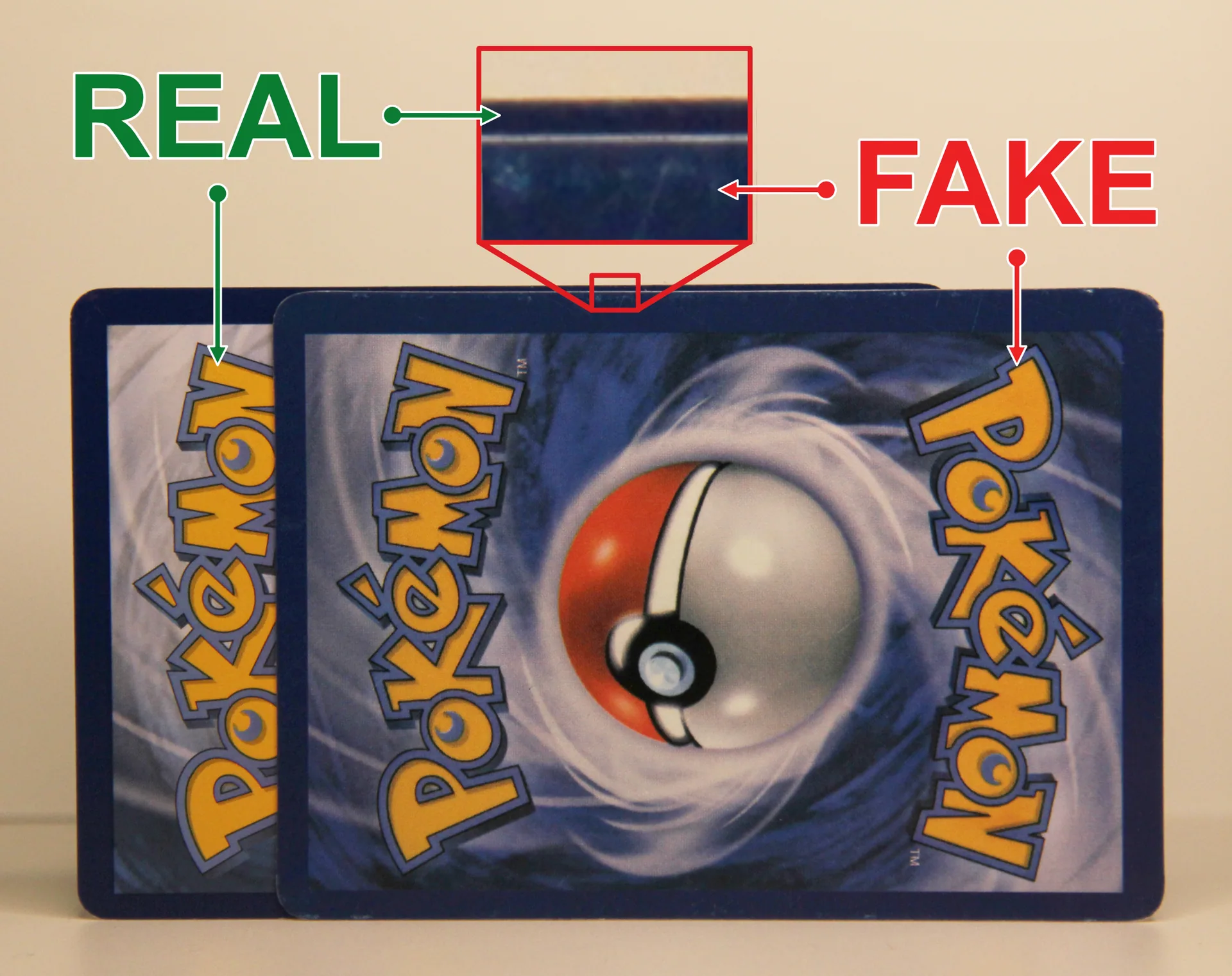
- Quick comparison method: Stack the suspect card on top of a known authentic card. Even tiny size differences – as small as 0.5 mm – become immediately visible when edges don't align.
- Precision measurement: A digital caliper can reveal a meaningful size difference, but allow for manufacturing tolerance, wear, damage, and measurement error. Confirm an unexpected result with other checks.
- Corner radius: Authentic cards have smoothly rounded corners with a consistent radius of approximately 3 mm. Sharp, uneven, or overly rounded corners indicate poor die-cutting.
Border Width
The yellow (or silver/gray on certain card types) border frame on the front and blue on the back should be even on all four sides:
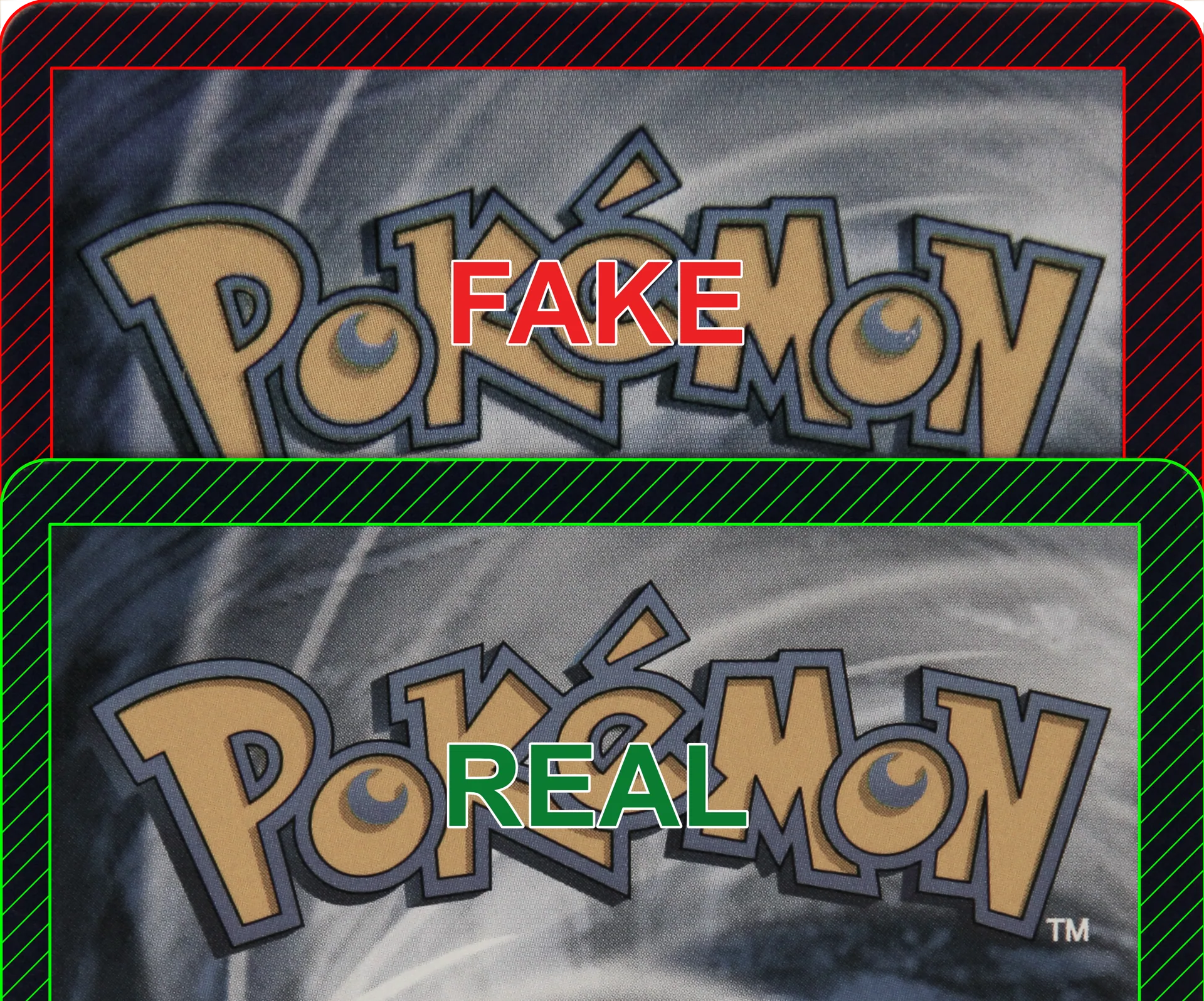
- Tolerance: Authentic cards may have slight centering variations, but border width differences greater than ±0.5 mm between opposite sides are suspicious. Grading companies penalize centering issues beyond 60/40, so extreme asymmetry is a red flag.
- Visual check: Hold the card at arm's length and compare the left border to the right, then top to bottom. Obvious thickness differences suggest off-model printing or cutting.
- Excessively thick borders: Some fakes display borders far thicker than genuine cards – a clear sign the counterfeiter used incorrect templates or scaling.
Front-to-Back Alignment
On authentic cards, the front and back artwork aligns when the card is cut. The misalignment sometimes also happens on authentic cards, so it is not a definitive indicator.
- Check method: Hold the card up to a light source or flip it repeatedly while watching the border edges. If the front border is noticeably wider on one side while the back border is wider on the opposite side, the print layers are misregistered.
- Interpretation: Minor misalignment can occur on genuine cards (especially older prints), but severe front-to-back offset – combined with other issues – strongly suggests a counterfeit.

Edge Inspection
Examine the card's cut edges closely:
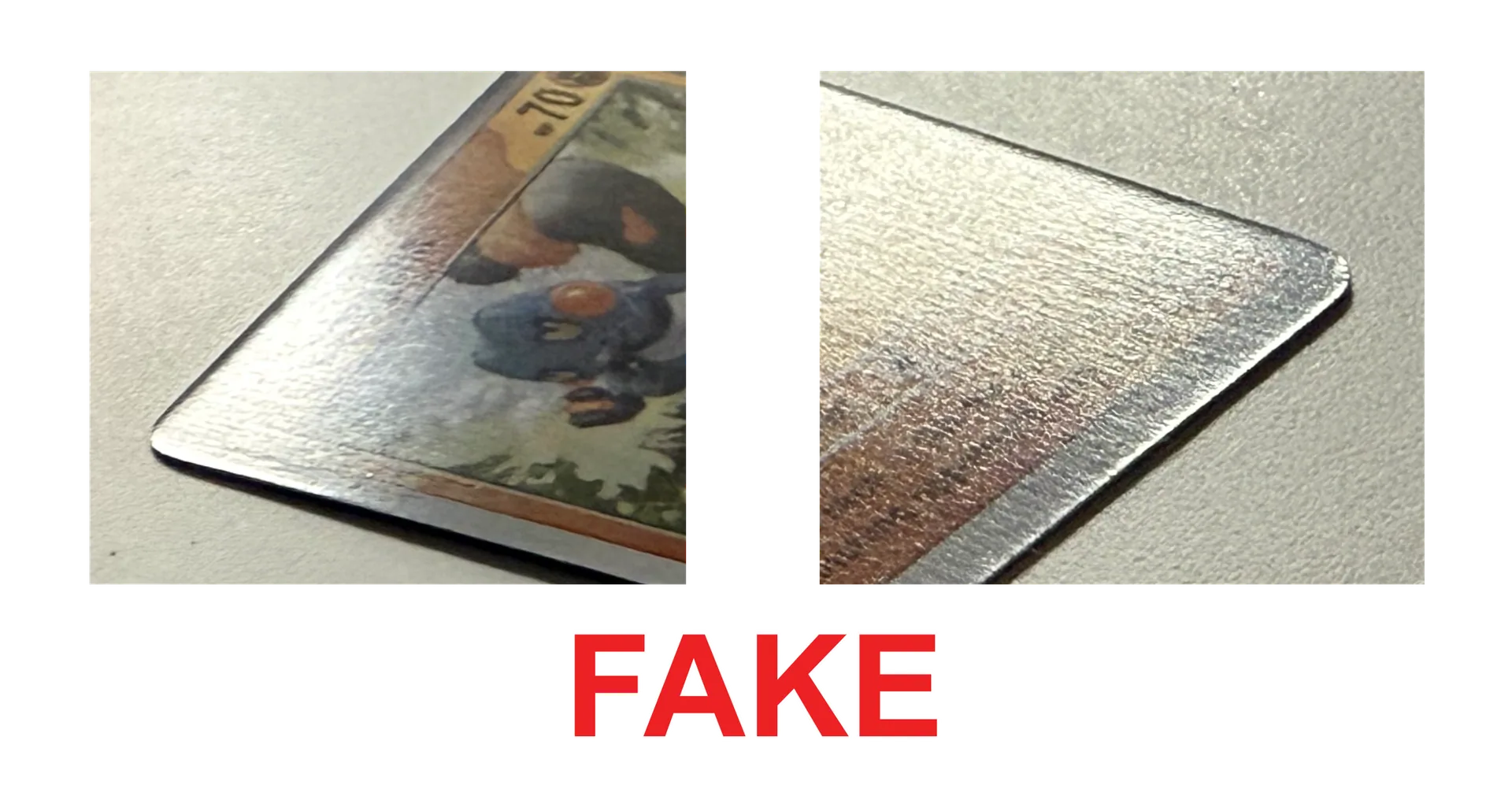
- Blue-gray core: Authentic English Pokémon cards are printed on layered cardstock with a dark (black or blue-gray) core sandwiched between white outer layers. When viewed from the side, this thin dark line should be visible. A bright white edge or visible paper layers indicate cheap single-layer stock.
- Clean cuts: Edges should be smooth and free of fraying, burrs, or cardboard residue. Rough or jagged edges suggest low-quality cutting equipment.
- Consistent thickness: The card should feel uniform in thickness. Warping, delamination, or uneven edges are warning signs.
Back is Weird Color
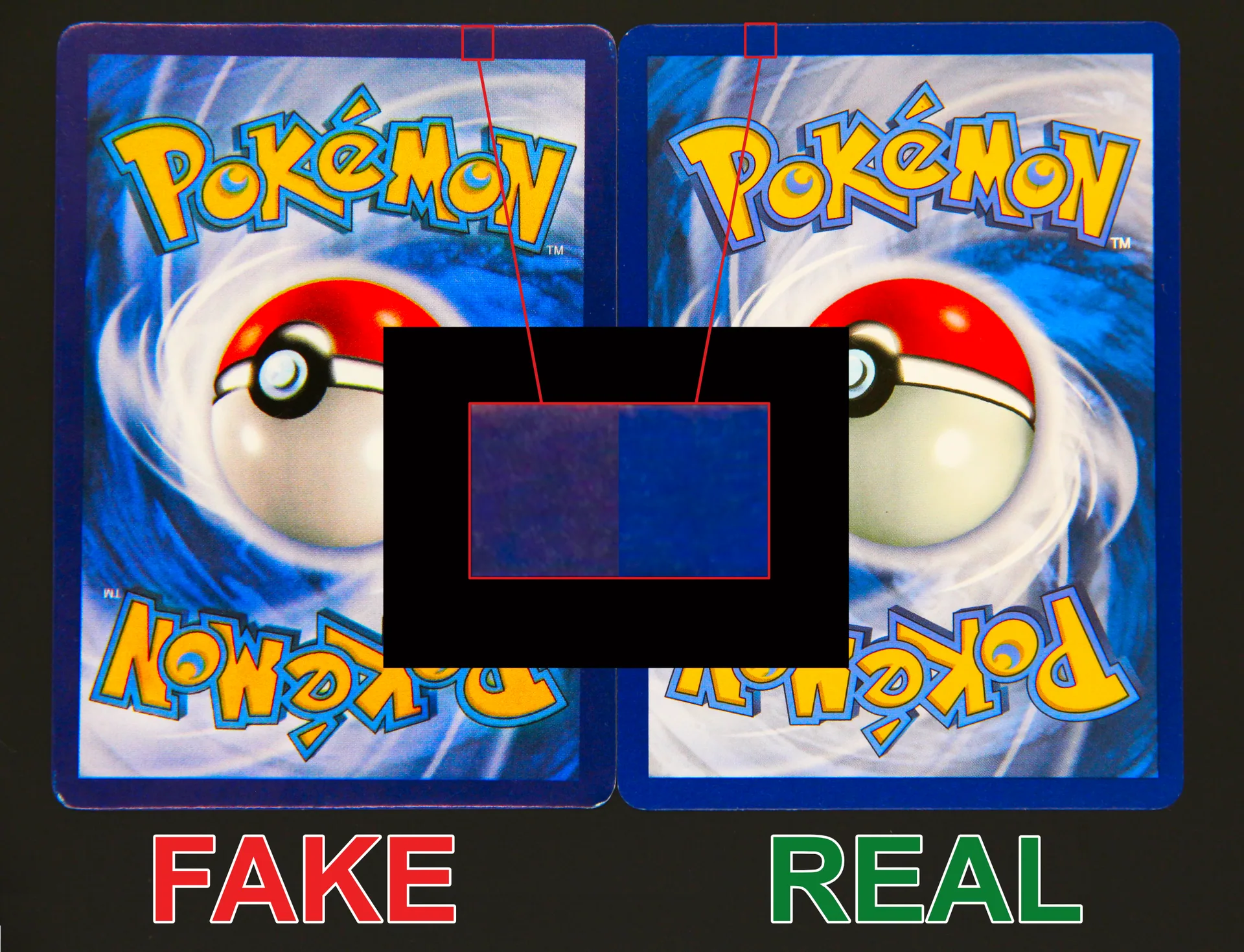
The card back is one of the quickest ways to spot a fake. Authentic Pokémon cards display a deep blue gradient with proper color saturation and smooth transitions. Counterfeits often show incorrect blue tones – too light, too purple, or lacking the characteristic gradient depth.
- What to check: Compare the suspect card's back against a known authentic card under neutral lighting.
- Common fake tells: Washed-out blues, overly purple tones, flat gradients, or muddy color transitions.
- Swirl pattern: The blue swirl pattern should have visual depth; fakes often appear flat or uniform.
Full Gold / Silver Back
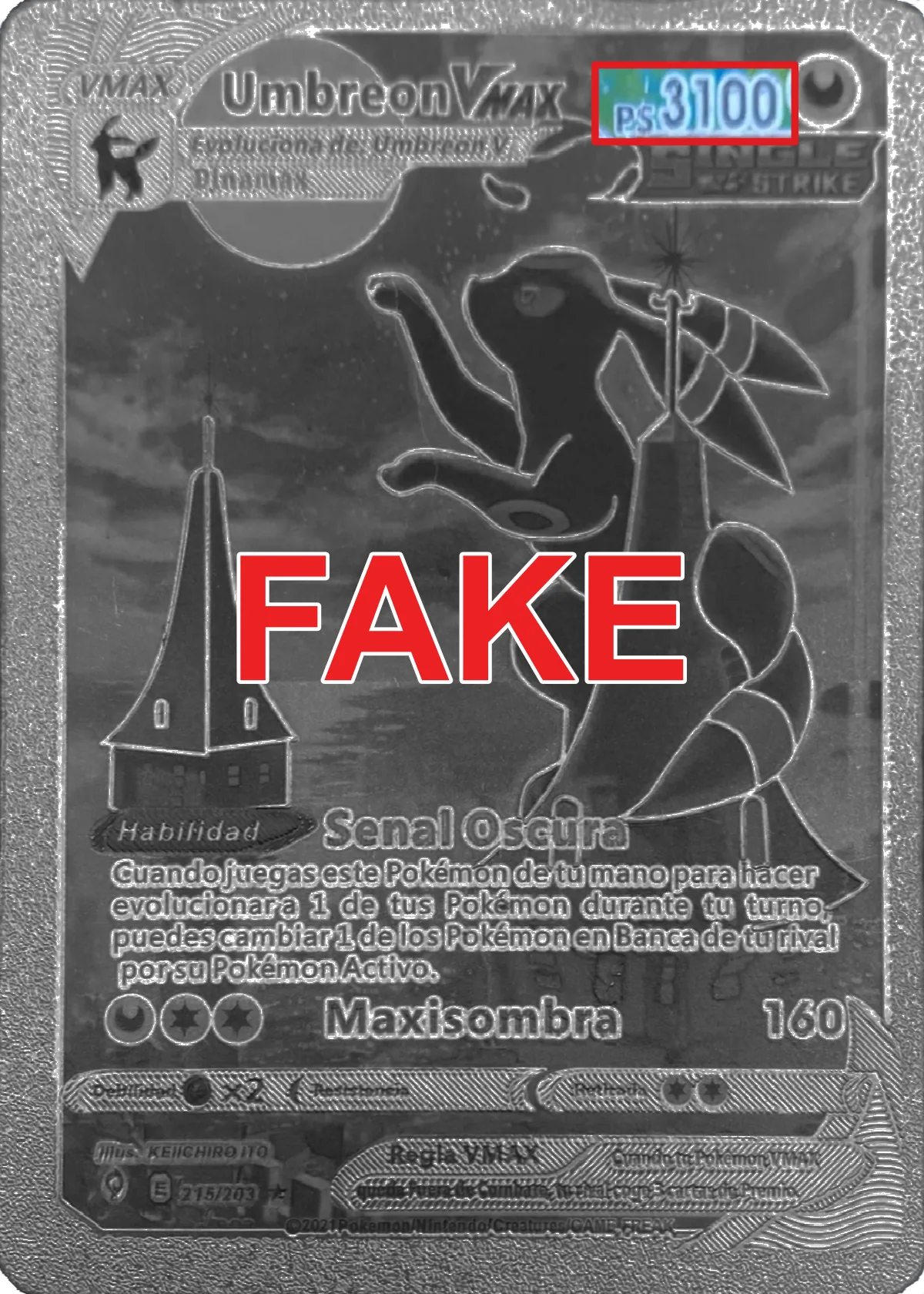
- Some novelty fakes feature entirely gold or silver metallic backs instead of the standard blue design used by ordinary paper cards.
- A metallic back is conclusive only when the item claims to be a normal paper printing. Official special products, including some metal collectible cards, are exceptions and must be checked against an exact reference.
- Often sold as "collector items" or in novelty bundles.

HP is Too High
- HP, attack damage, and energy costs should make sense for the era and rarity.
- Values such as 1000 HP or 3100 HP are a strong warning on ordinary playable cards, but confirm the exact product because novelty and non-standard official products can follow different rules.
- Abilities and attacks should reference the correct energy types; mismatched icons are strong tells.
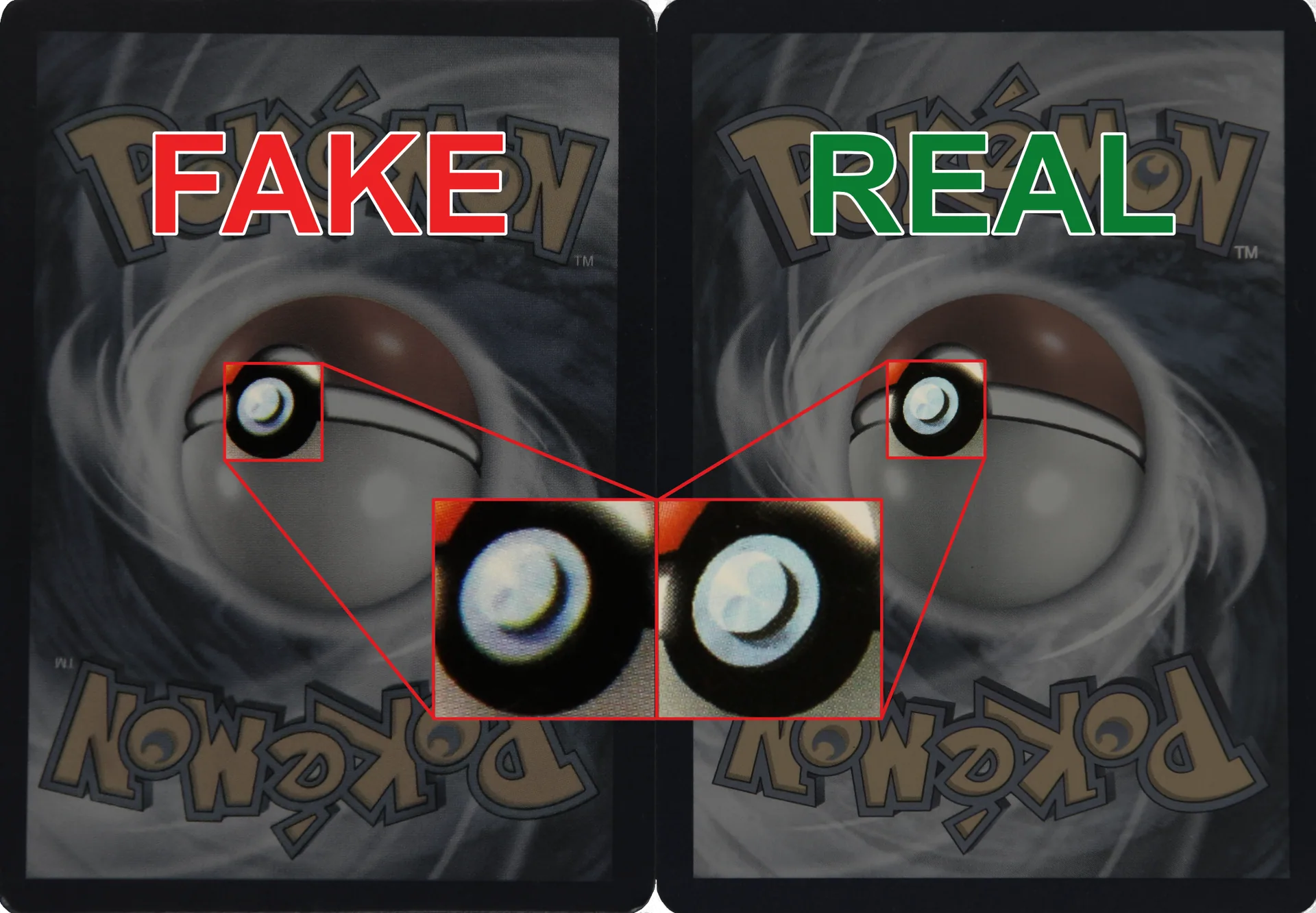
Poké Ball Center Must Be Crisp
- The Poké Ball center ring on the card back remains crisp on authentic cards.
- Blurry rings, muddy reds, or poorly defined edges suggest poor printing.
- Compare the white highlight and red gradient: they should be smooth and well-defined.
Weakness/Resistance/Regulation Mark Errors
The bottom portion of a Pokémon card contains several small but critical elements that counterfeiters frequently get wrong. Use the example below to learn where each element belongs.
- Weakness box (1): Shows the type icon the Pokémon is weak to, followed by the multiplier.
- Resistance box (2): Shows the type icon the Pokémon resists, followed by the reduction value. Not all cards have resistance – its absence is normal on some Pokémon.
- Retreat cost (3): Displays Colorless energy symbols indicating energy is needed to retreat.
- Regulation mark (4): Modern cards (Sword & Shield onward) display a letter (D, E, F, G, or H) in the bottom-left corner indicating the card's tournament-legal era.
- Set code and collector number (5): Located near the bottom-left, showing the set abbreviation and card position (e.g., "PRE 077/131").
- Rarity symbol (6): Found near the collector number.
- Classic era (Base Set through Sword & Shield): circle (●) common, diamond (◆) uncommon, star (★) rare, star with "H" (★H) holo rare.
- Scarlet & Violet era (2023+): same base symbols plus double star (★★) double rare (ex/Tera cards), triple star (★★★) ultra rare, "AR" art rare, "SAR" special art rare (full-art illustrations), "SIR" special illustration rare, "UR" ultra rare, and "HR" hyper rare (gold cards). Promo cards use a star with "PROMO" text.
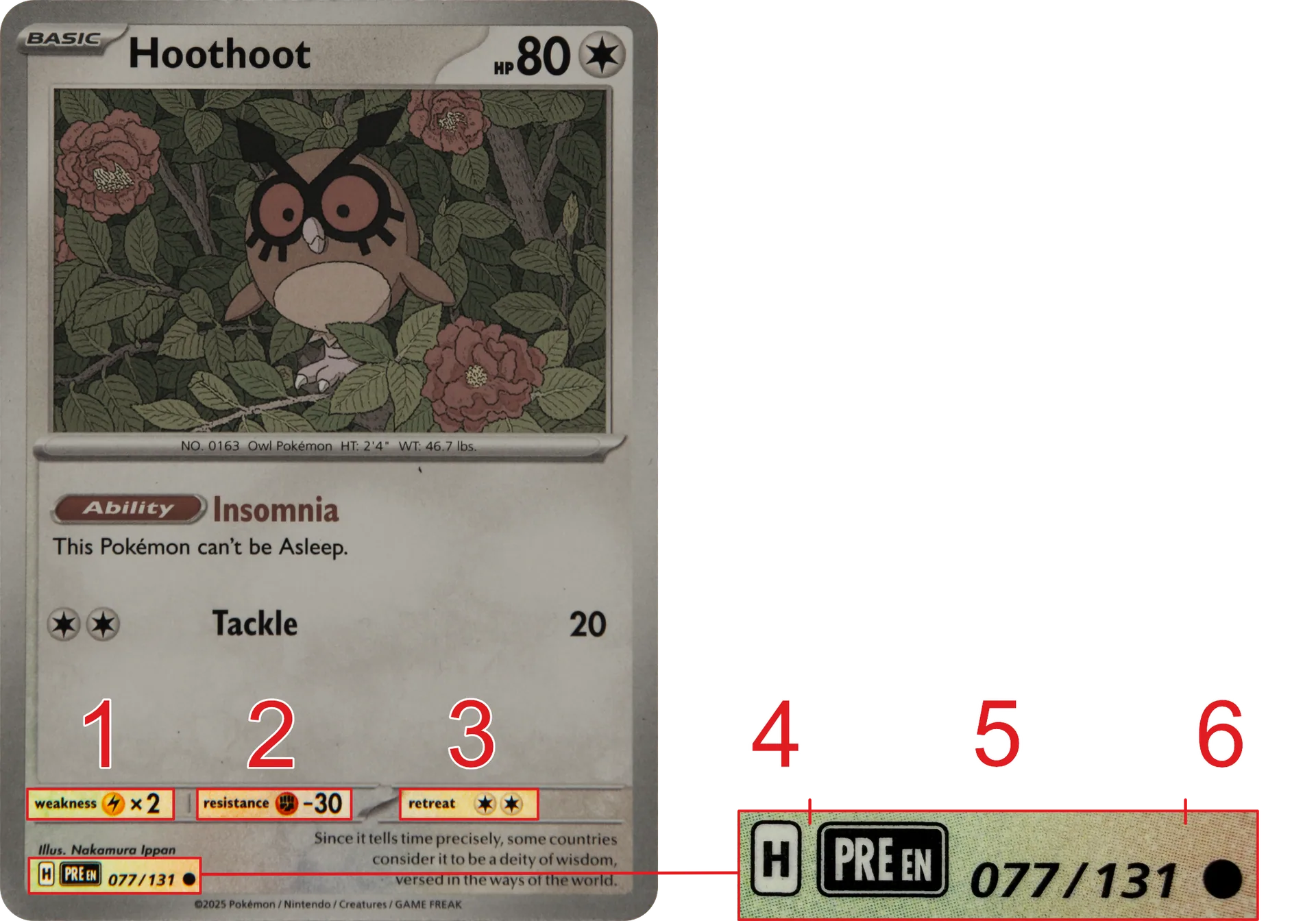
H indicating Scarlet & Violet era legality, (5) set code PRE with collector number 077/131, (6) common rarity symbol (●). Open full-size image (opens in a new tab)Wrong or Missing Card Number
Almost every authentic Pokémon card displays a unique collector number, typically printed in the bottom-right or bottom-left corner of the card front. This number identifies the card's position within its set (e.g., "078/132" means card 78 of 132 in the set).
- Quick visual check: Locate the collector number. If it's missing entirely on a card that should have one, the card is almost certainly fake.
- Number validation: The first number should not exceed the second (except for secret rares, which intentionally have higher numbers like "150/132"). If the numbering makes no sense – such as "999/132" – the card is fake.
- Set matching: The collector number should correspond to the correct set. If you know the set (from the set symbol or logo), verify the number falls within that set's range.
- Rare exceptions: Some promotional cards and special releases may lack collector numbers. When in doubt, search for the specific card to confirm whether a number should be present.
This check requires no reference card and takes only seconds – making it one of the fastest ways to catch low-effort counterfeits.
Fake "2nd Edition" Stamps
There is no such thing as a "2nd Edition" stamp in the Pokémon TCG. Any card displaying a "2nd Edition" mark is definitively fake.
- 1st Edition history: Early English sets included a small "Edition 1" (commonly called "1st Edition") stamp to mark the initial limited print run. These stamps appeared on the left side of the card, below the artwork.
- Unlimited prints: Cards printed after the 1st Edition run are officially called "Unlimited" and never carried any edition stamp. The card layout is otherwise identical.
- Timeline: The last English set to include 1st Edition stamps was Neo Destiny (2002). Japanese cards continued featuring 1st Edition stamps until XY Evolutions (2016).
- Common misconception: Some collectors mistakenly refer to Unlimited prints as "2nd Edition" cards, but this terminology is incorrect. No genuine Pokémon card has ever been printed with a "2nd Edition" stamp.
If you encounter a card with a "2nd Edition" stamp – regardless of how authentic it otherwise appears – it is a guaranteed fake.